|
Perl+MySQL Page posted: 2015-04-27 14:45
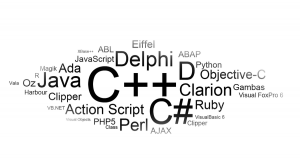 Computer programming (often shortened to programming)
is the comprehensive process that leads from an original formulation of a computing problem to executable programs. It involves
activities such as analysis, understanding, and generically solving such problems resulting in an algorithm, verification of
requirements of the algorithm including its correctness and its resource consumption, implementation (or coding) of the algorithm
in a target programming language, testing, debugging, and maintaining the source code, implementation of the build system and management
of derived artefacts such as machine code of computer programs. The algorithm is often only represented in human-parseable form and
reasoned about using logic. Source code is written in one or more programming languages (such as C++, C#, Java, Python, Smalltalk,
JavaScript, etc.). The purpose of programming is to find a sequence of instructions that will automate performing a specific task or
solve a given problem. The process of programming thus often requires expertise in many different subjects, including knowledge of
the application domain, specialized algorithms and formal logic.
Within software engineering, programming (the implementation) is regarded as one phase in a software development process.
There is an on-going debate on the extent to which the writing of programs is an art form, a craft, or an engineering discipline.
In general, good programming is considered to be the measured application of all three, with the goal of producing an efficient and
evolvable software solution (the criteria for „efficient“ and „evolvable“ vary considerably). The discipline differs from many other
technical professions in that programmers, in general, do not need to be licensed or pass any standardized (or governmentally regulated)
certification tests in order to call themselves „programmers“ or even „software engineers.“ Because the discipline covers many areas,
which may or may not include critical applications, it is debatable whether licensing is required for the profession as a whole. In most
cases, the discipline is self-governed by the entities which require the programming, and sometimes very strict environments are defined
(e.g. United States Air Force use of AdaCore and security clearance). However, representing oneself as a „Professional Software Engineer“
without a license from an accredited institution is illegal in many parts of the world.
Another on-going debate is the extent to which the programming language used in writing computer programs affects the form that the
final program takes. This debate is analogous to that surrounding the Sapir–Whorf hypothesis in linguistics and cognitive science, which
postulates that a particular spoken language’s nature influences the habitual thought of its speakers. Different language patterns yield
different patterns of thought. This idea challenges the possibility of representing the world perfectly with language, because it
acknowledges that the mechanisms of any language condition the thoughts of its speaker community. Computer programming (often shortened to programming)
is the comprehensive process that leads from an original formulation of a computing problem to executable programs. It involves
activities such as analysis, understanding, and generically solving such problems resulting in an algorithm, verification of
requirements of the algorithm including its correctness and its resource consumption, implementation (or coding) of the algorithm
in a target programming language, testing, debugging, and maintaining the source code, implementation of the build system and management
of derived artefacts such as machine code of computer programs. The algorithm is often only represented in human-parseable form and
reasoned about using logic. Source code is written in one or more programming languages (such as C++, C#, Java, Python, Smalltalk,
JavaScript, etc.). The purpose of programming is to find a sequence of instructions that will automate performing a specific task or
solve a given problem. The process of programming thus often requires expertise in many different subjects, including knowledge of
the application domain, specialized algorithms and formal logic.
Within software engineering, programming (the implementation) is regarded as one phase in a software development process.
There is an on-going debate on the extent to which the writing of programs is an art form, a craft, or an engineering discipline.
In general, good programming is considered to be the measured application of all three, with the goal of producing an efficient and
evolvable software solution (the criteria for „efficient“ and „evolvable“ vary considerably). The discipline differs from many other
technical professions in that programmers, in general, do not need to be licensed or pass any standardized (or governmentally regulated)
certification tests in order to call themselves „programmers“ or even „software engineers.“ Because the discipline covers many areas,
which may or may not include critical applications, it is debatable whether licensing is required for the profession as a whole. In most
cases, the discipline is self-governed by the entities which require the programming, and sometimes very strict environments are defined
(e.g. United States Air Force use of AdaCore and security clearance). However, representing oneself as a „Professional Software Engineer“
without a license from an accredited institution is illegal in many parts of the world.
Another on-going debate is the extent to which the programming language used in writing computer programs affects the form that the
final program takes. This debate is analogous to that surrounding the Sapir–Whorf hypothesis in linguistics and cognitive science, which
postulates that a particular spoken language’s nature influences the habitual thought of its speakers. Different language patterns yield
different patterns of thought. This idea challenges the possibility of representing the world perfectly with language, because it
acknowledges that the mechanisms of any language condition the thoughts of its speaker community.
 Perl is a family of high-level, general-purpose,
interpreted, dynamic programming languages. The languages in this family include Perl 5 and Perl 6.
Though Perl is not officially an acronym, there are various backronyms in use, such as: Practical Extraction and Reporting Language.
Perl was originally developed by Larry Wall in 1987 as a general-purpose Unix scripting language to make report processing easier.
Since then, it has undergone many changes and revisions. The latest major stable revision of Perl 5 is 5.18, released in May 2013.
Perl 6, which began as a redesign of Perl 5 in 2000, eventually evolved into a separate language. Both languages continue to be developed
independently by different development teams and liberally borrow ideas from one another.
The Perl languages borrow features from other programming languages including C, shell scripting (sh), AWK, and sed. They provide powerful
text processing facilities without the arbitrary data-length limits of many contemporary Unix commandline tools, facilitating easy manipulation
of text files. Perl 5 gained widespread popularity in the late 1990s as a CGI scripting language, in part due to its parsing abilities.
In addition to CGI, Perl 5 is used for graphics programming, system administration, network programming, finance, bioinformatics,
and other applications. It is nicknamed „the Swiss Army chainsaw of scripting languages“ because of its flexibility and power,
and possibly also because of its „ugliness“. In 1998, it was also referred to as the „duct tape that holds the Internet together“,
in reference to its ubiquitous use as a glue language and inelegance. Perl is a family of high-level, general-purpose,
interpreted, dynamic programming languages. The languages in this family include Perl 5 and Perl 6.
Though Perl is not officially an acronym, there are various backronyms in use, such as: Practical Extraction and Reporting Language.
Perl was originally developed by Larry Wall in 1987 as a general-purpose Unix scripting language to make report processing easier.
Since then, it has undergone many changes and revisions. The latest major stable revision of Perl 5 is 5.18, released in May 2013.
Perl 6, which began as a redesign of Perl 5 in 2000, eventually evolved into a separate language. Both languages continue to be developed
independently by different development teams and liberally borrow ideas from one another.
The Perl languages borrow features from other programming languages including C, shell scripting (sh), AWK, and sed. They provide powerful
text processing facilities without the arbitrary data-length limits of many contemporary Unix commandline tools, facilitating easy manipulation
of text files. Perl 5 gained widespread popularity in the late 1990s as a CGI scripting language, in part due to its parsing abilities.
In addition to CGI, Perl 5 is used for graphics programming, system administration, network programming, finance, bioinformatics,
and other applications. It is nicknamed „the Swiss Army chainsaw of scripting languages“ because of its flexibility and power,
and possibly also because of its „ugliness“. In 1998, it was also referred to as the „duct tape that holds the Internet together“,
in reference to its ubiquitous use as a glue language and inelegance.
 MySQL ("My S-Q-L", officially, but also called
"My Sequel") is (as of July 2013) the world's second most[a] widely used relational database management system (RDBMS) and most widely used
open-source RDBMS. It is named after co-founder Michael Widenius's daughter, The SQL acronym stands for Structured Query Language.
The MySQL development project has made its source code available under the terms of the GNU General Public License, as well as under a variety
of proprietary agreements. MySQL was owned and sponsored by a single for-profit firm, the Swedish company MySQL AB, now owned by Oracle Corporation.
MySQL is a popular choice of database for use in web applications, and is a central component of the widely used LAMP open source web application
software stack (and other 'AMP' stacks). LAMP is an acronym for "Linux, Apache, MySQL, Perl/PHP/Python." Free-software-open source projects that
require a full-featured database management system often use MySQL.
For proprietary use, several paid editions are available, and offer additional functionality. Applications which use MySQL databases include: TYPO3,
MODx, Joomla, WordPress, phpBB, MyBB, Drupal and other software. MySQL is also used in many high-profile, large-scale websites, including Google
(though not for searches), Facebook, Twitter, Flickr and YouTube MySQL ("My S-Q-L", officially, but also called
"My Sequel") is (as of July 2013) the world's second most[a] widely used relational database management system (RDBMS) and most widely used
open-source RDBMS. It is named after co-founder Michael Widenius's daughter, The SQL acronym stands for Structured Query Language.
The MySQL development project has made its source code available under the terms of the GNU General Public License, as well as under a variety
of proprietary agreements. MySQL was owned and sponsored by a single for-profit firm, the Swedish company MySQL AB, now owned by Oracle Corporation.
MySQL is a popular choice of database for use in web applications, and is a central component of the widely used LAMP open source web application
software stack (and other 'AMP' stacks). LAMP is an acronym for "Linux, Apache, MySQL, Perl/PHP/Python." Free-software-open source projects that
require a full-featured database management system often use MySQL.
For proprietary use, several paid editions are available, and offer additional functionality. Applications which use MySQL databases include: TYPO3,
MODx, Joomla, WordPress, phpBB, MyBB, Drupal and other software. MySQL is also used in many high-profile, large-scale websites, including Google
(though not for searches), Facebook, Twitter, Flickr and YouTube
From Wikipedia, the free encyclopedia
|